
Your glasses prescription is not a contact lens prescription, and attempting to use them interchangeably could compromise your eye health. It is common to feel frustrated when you realize a separate exam and fitting are required for lenses, especially when you are already familiar with your vision needs. At The Eye Centre #YourVisionOurPassion, we recognize that the technical abbreviations and different measurement requirements can be confusing. Since approximately 45 million Americans now wear lenses to correct their vision, understanding the specific details of your eye health documents is more important than ever.
We believe in providing premium quality with affordable price options so that every patient can access the right care. This guide will help you understand the specific numbers on your prescription and the functional differences between daily and monthly wear lenses. You will also discover why a professional fitting is a legal and medical necessity for your safety. By the end of this article, you will know exactly how to interpret your vision care needs for 2026 while ensuring your eyes remain healthy and comfortable.
Key Takeaways
- Identify why a contact lens prescription requires specific measurements like base curve and diameter that are never found on a standard glasses prescription.
- Decode common technical terms like OD and OS to help you feel more confident and informed when discussing your vision health.
- Compare the hygiene advantages of daily disposables with the cost-effectiveness of monthly wear to determine which option suits your lifestyle.
- Learn how to access premium quality with affordable price options for your vision care needs without compromising on medical standards.
- Realize the clinical necessity of a professional fitting at The Eye Centre #YourVisionOurPassion to ensure your lenses provide clear and comfortable vision.
Comparing Contact Lens Prescriptions and Glasses Prescriptions
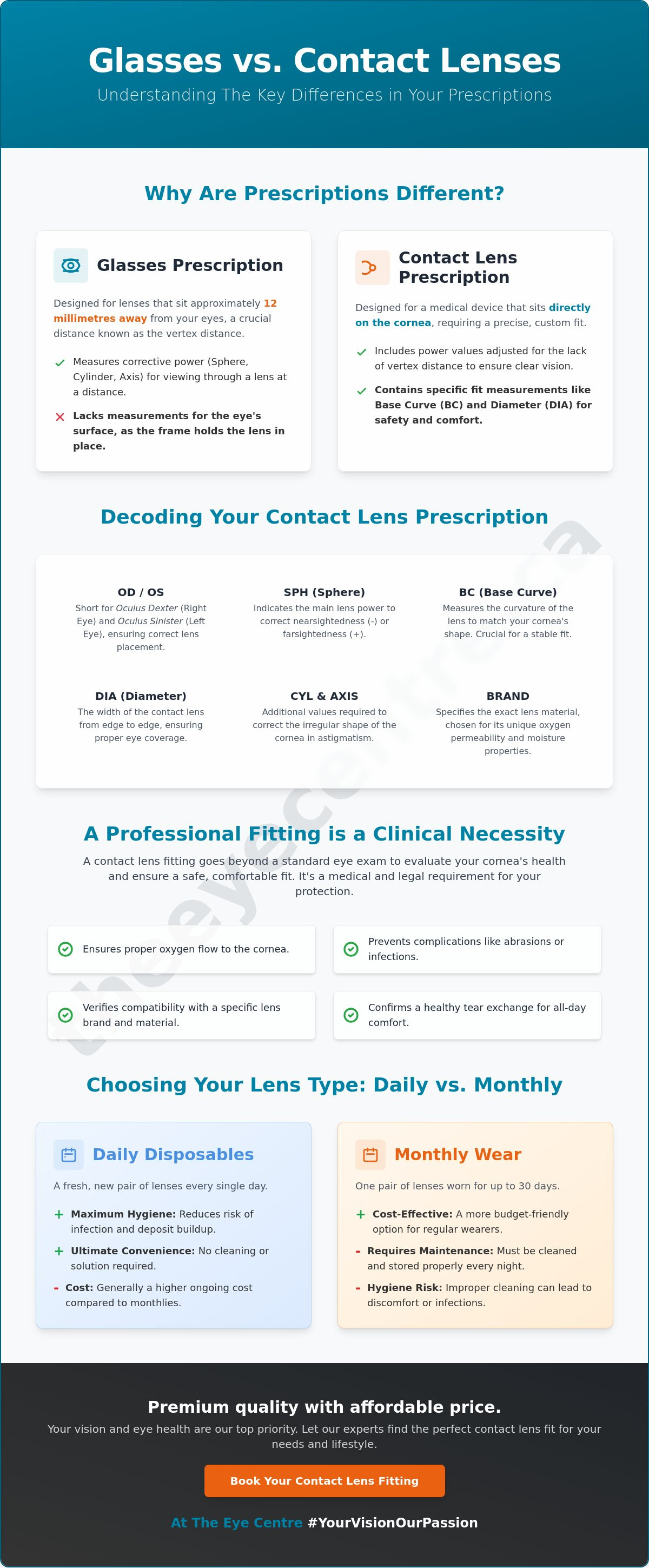
A common misconception is that the numbers on your glasses prescription can be used to order contact lenses. This is inaccurate because a lens sitting 12 millimetres away from your face performs differently than one resting directly on your cornea. This physical gap, known as vertex distance, requires a specific calculation to adjust the corrective power. Because of this, your contact lens prescription will frequently have different power values than your glasses to ensure you see clearly at all distances.
Beyond the corrective power, glasses documents lack the physical dimensions required to safely fit a medical device to your eye. A lens requires a base curve (BC) and a diameter (DIA). These figures act like a clothing size for your eye, ensuring the lens matches the unique curvature of your ocular surface. Without these measurements, a lens could fit too tightly, which may starve the eye of oxygen, or too loosely, which causes constant irritation and blurred vision. Understanding Contact lens basics provides a foundation for why these specific measurements are vital for long-term health.
Why One Size Does Not Fit All in Vision Care
Every individual has a unique corneal shape and tear film composition. The lens must interact harmoniously with your natural tears to remain hydrated and comfortable. Using a glasses prescription to purchase contacts often leads to poor vision and physical discomfort. At The Eye Centre #YourVisionOurPassion, we ensure every patient understands these technical distinctions to prevent complications like corneal abrasions or infections. We focus on providing premium quality with affordable price options so you don't have to compromise on safety.
The Clinical Necessity of a Contact Lens Fitting
A standard eye exam focuses on your sight, but a fitting at our Fort McMurray or Yorkton clinics evaluates the physical health of your cornea. During this process, our team uses specialized imaging to check for a precise fit and healthy tear exchange. This professional oversight is the only way to verify that a specific lens brand is compatible with your eye's physiology. You can learn more about this process in our contact lens trial guide, which details how we find the right match for your lifestyle.
Decoding the Numbers: How to Read Your Contact Lens Prescription
Reading a contact lens prescription for the first time can feel like looking at a coded message. At The Eye Centre #YourVisionOurPassion, we believe that informed patients make the healthiest choices for their vision. Your document will start with OD (Oculus Dexter), which refers to your right eye, and OS (Oculus Sinister), which refers to your left eye. These professional terms help ensure that the correct correction is applied to each eye during the manufacturing and dispensing process.
Unlike glasses, these documents include a Base Curve (BC) and Diameter (DIA). Think of these as the clothing size for your eye. The BC measures the curvature of the back of the lens, while the DIA indicates the total width. A lens that fits perfectly prevents irritation and ensures the cornea remains healthy. Understanding FDA contact lens prescription requirements can clarify how these medical devices are regulated to protect consumers from improper use and poor fit.
One unique aspect of vision care in Canada is the clinical requirement to specify a lens brand. This is because different brands use distinct materials, such as silicone hydrogel, which vary in oxygen permeability and moisture retention. While some online retailers might suggest brands are interchangeable, your optometrist selects a specific material based on your eye's physiological needs. We offer premium quality with affordable price options across all prescribed brands to ensure you receive the exact care required. If your current lenses feel dry or uncomfortable, it may be time to schedule a comprehensive review of your ocular health.
Common Abbreviations You Will Encounter
SPH (Sphere) indicates the lens power needed to correct nearsightedness or farsightedness. If you have astigmatism, your prescription will also include CYL (Cylinder) and AXIS values. For those who require help with both near and far vision, an ADD power is used for multifocal contact lenses. These numbers work together to provide clear, stable vision throughout your daily activities.
The Importance of the Expiry Date
Most Canadian prescriptions are valid for one or two years. The cornea is a living tissue that can change shape or health status over time, especially when a lens is resting on it daily. An expired prescription is a safety measure, not just a paperwork requirement. Routine checks allow us to catch subtle changes in corneal health or tear production before they become painful problems.
Daily Disposables vs. Monthly Wear: Comparing Prescription Types
Choosing the right lens replacement schedule is a significant part of your contact lens prescription process. Your optometrist considers your tear film quality and daily habits before recommending a specific type. While some focus only on the price, we prioritize a balance where you receive premium quality with affordable price options. For those active in sports or frequent travel, daily disposables eliminate the need for carrying solutions. Conversely, patients in consistent office environments might prefer the routine of monthly lenses. If you experience dry eye symptoms, daily lenses are often the preferred choice. They reduce the accumulation of protein deposits that can aggravate sensitive eyes. At The Eye Centre #YourVisionOurPassion, our goal is to help you look and see your best by matching the technology to your physiology.
Daily Disposables: The Gold Standard for Eye Health
These are often considered the gold standard for hygiene. Since you discard the lens at the end of the day, there's no risk of bacteria buildup from improper storage. This is particularly beneficial for Canadians dealing with seasonal allergies or ocular sensitivity. You can find more details on what is legally required on these documents by reviewing the official guide on Understanding Your Contact Lens Prescription. We offer premium quality with affordable price points for top-tier daily brands to ensure your eyes stay hydrated throughout the day.
Monthly and Extended Wear: Consistency and Value
Monthly lenses offer excellent value for those who don't mind a nightly cleaning routine. To maintain safety and prevent infection, you must follow a strict regimen. Use this checklist to determine if monthly maintenance fits your lifestyle:
- Can you commit to washing and drying your hands thoroughly before every lens handling?
- Are you prepared to rub and rinse the lenses with fresh multipurpose solution every night?
- Will you remember to replace your lens case every three months?
- Do you understand that you must never use tap water to rinse your lenses?
If you find these steps difficult to maintain, daily disposables may be a safer alternative. Your quality of vision is too important to ignore, and we are here to guide you toward the most appropriate choice for your needs.
Secure Your Vision for the Future
Understanding your contact lens prescription is the first step toward maintaining healthy eyes and achieving sharp vision. You now realize that these documents are specialized medical records that differ from glasses prescriptions because of the physical requirements of the lens sitting directly on your cornea. Whether you choose the hygiene of daily disposables or the value of monthly wear, a professional fitting ensures your lenses are safe and comfortable.
At The Eye Centre #YourVisionOurPassion, we provide comprehensive fittings at our locations in Fort McMurray, Prince Albert, and Yorkton. We offer evening and weekend appointments to fit your busy schedule, ensuring you never have to compromise on your eye health. Our team is dedicated to providing premium quality with affordable price options for every patient. Book your professional contact lens fitting at The Eye Centre today. Your quality of vision is too important to ignore, and we look forward to helping you look and see with clarity.
Common Questions About Vision Care
Can I use my glasses prescription to order contact lenses online?
No, you cannot use a glasses prescription to order contact lenses. These documents are distinct because glasses sit approximately 12mm away from your face while contacts rest directly on the eye. A contact lens prescription includes specific measurements like base curve and diameter that are absent from glasses records. At The Eye Centre #YourVisionOurPassion, we ensure these measurements are precise to prevent ocular health issues and ensure a comfortable fit.
How long is a contact lens prescription valid for in Canada?
In Canada, a contact lens prescription is typically valid for one to two years. This duration allows your optometrist to monitor the health of your cornea and ensure the lenses are not causing adverse reactions or starving the eye of oxygen. Regular assessments are vital because your eyes can change over time. We provide premium quality with affordable price options for these follow-up visits to help you maintain your long-term vision health.
What is the difference between a contact lens exam and a regular eye exam?
A regular eye exam focuses on your general ocular health and sight, while a contact lens exam adds a specialized fitting process. During this fitting, we measure the curvature of your eye and evaluate how a specific lens interacts with your tear film. This ensures the lens moves correctly and provides stable vision. It is an essential step for anyone looking to wear lenses safely without causing irritation or damage to the corneal surface.
Why does my contact lens prescription specify a certain brand?
Your prescription specifies a brand because every manufacturer uses unique materials with varying levels of oxygen permeability and moisture retention. The fit of a lens can change significantly between brands even if the power remains the same. At The Eye Centre #YourVisionOurPassion, we select brands that match your specific eye physiology to ensure you look and see your best. This clinical choice prevents complications that often arise from switching to unapproved materials.
Is it possible to have a different prescription for each eye?
Yes, it is common to have a different prescription for each eye. Most people have variations in the shape or refractive power of their right and left eyes. Your optometrist will provide specific values for your OD (right eye) and OS (left eye) to ensure balanced vision. This personalized approach is necessary to provide the clarity and comfort required for your daily lifestyle. We offer premium quality with affordable price options for all lens types to accommodate these differences.
What happens if I wear contacts with the wrong prescription?
Wearing the wrong prescription can lead to significant eye strain, headaches, and blurred vision. If the physical fit is incorrect, you might also experience physical discomfort or even corneal damage due to a lack of oxygen. Your quality of vision is too important to ignore; therefore, using an accurate and up-to-date document is essential for protecting your eyes. Professional oversight helps you avoid these risks and maintains the health of your ocular surface over time.


