
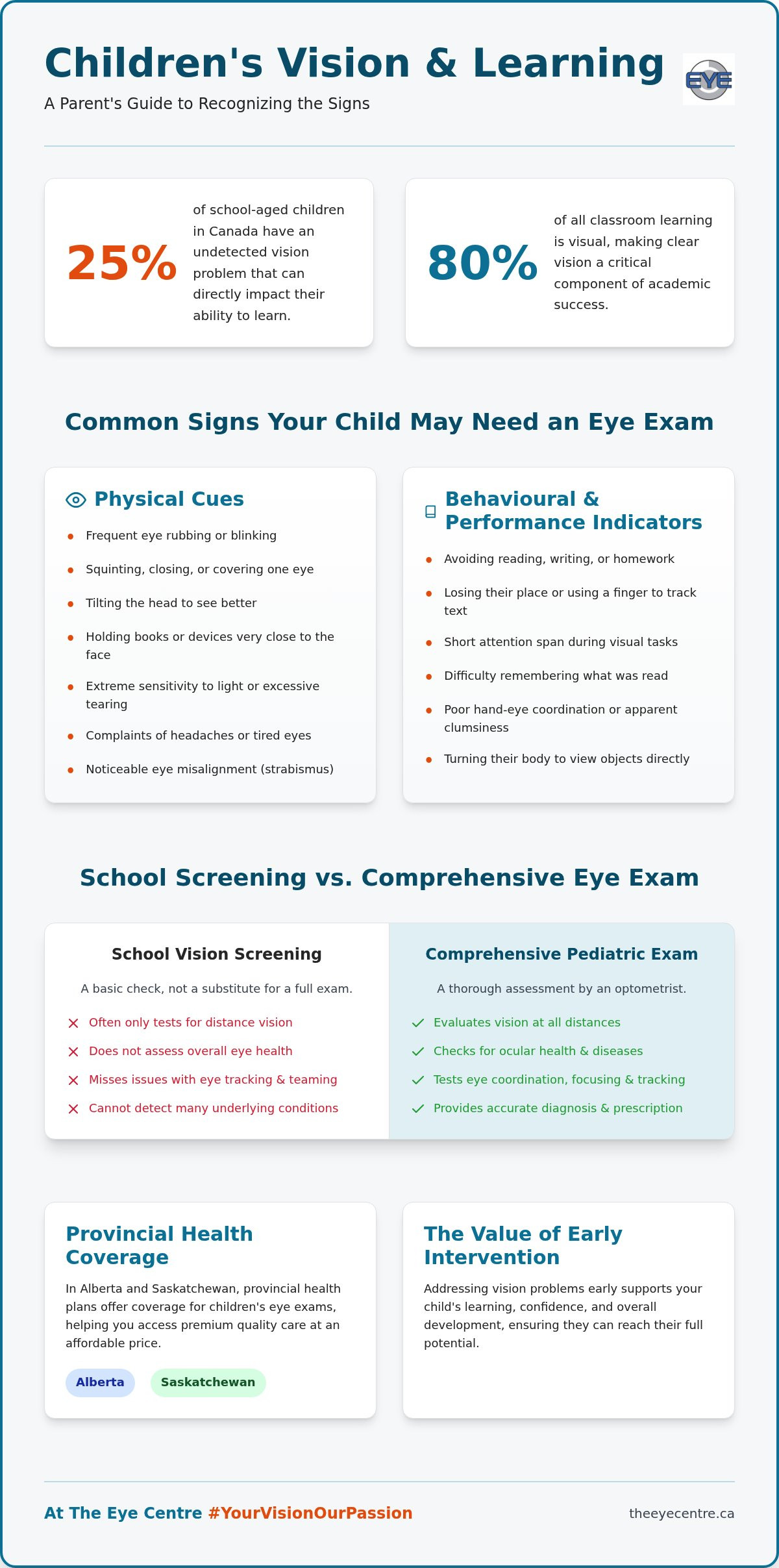
Did you know that nearly 25% of school-aged children in Canada have an undetected vision problem that directly impacts their ability to learn? Since approximately 80% of classroom learning is visual, unrecognized issues can quickly lead to frustration and falling grades. As a parent, it's natural to worry when your child struggles with homework or seems unusually tired after school. You want to provide them with premium quality care at an affordable price to ensure they reach their full potential. At The Eye Centre #YourVisionOurPassion, we know that recognizing the early signs your child needs an eye exam is the first step toward protecting their academic future and long-term well-being.
In this guide, you'll learn to spot the subtle physical and behavioural indicators that suggest your child may require a professional assessment. We'll clarify why a school vision screening isn't a substitute for a comprehensive exam and outline the provincial health coverage available in Alberta and Saskatchewan. We provide a clear checklist of symptoms to watch for, helping you decide when it's time to visit a family-oriented optometrist for a pediatric eye exam. Your child's quality of vision is too important to ignore, and early intervention ensures they can look and see clearly while reaching their development milestones.
Key Takeaways
- Identify physical cues like frequent eye rubbing or squinting that often signal vision strain or irritation in young children.
- Recognize the subtle behavioural signs your child needs an eye exam, such as avoiding reading or losing their place while following text on a page.
- Understand why school vision screenings are limited and how a comprehensive pediatric eye exam provides a thorough assessment of ocular health and coordination.
- Learn about provincial health coverage in Alberta and Saskatchewan to access premium quality care at an affordable price for your family.
- Discover how early intervention supports school success and developmental milestones at The Eye Centre #YourVisionOurPassion.
Recognizing Physical Signs of Vision Issues in Children
Physical symptoms often serve as the first warning that a child's visual system is under stress. Squinting or closing one eye while watching television or looking at a chalkboard are common signs your child needs an eye exam; these actions temporarily change the eye's shape to help focus. Persistent eye rubbing is another indicator. While often dismissed as tiredness, frequent rubbing suggests eye strain or irritation caused by the effort required to maintain a clear image. At The Eye Centre #YourVisionOurPassion, we emphasize that these physical behaviours are direct requests for professional support. Extreme sensitivity to light or excessive tearing should also be monitored, as these can signal underlying ocular health issues that require clinical attention.
Subtle Physical Cues Parents Often Overlook
Some indicators are less obvious than a squint. Children may tilt their head or turn it to one side to compensate for a misalignment or a "lazy eye." This adjustment helps them use their stronger eye effectively. You might also notice them holding books or digital tablets unusually close to their face to realize better clarity. If your child complains of frequent headaches or a dull brow ache after school or reading, it's often a sign of the physical fatigue associated with uncorrected vision. These subtle cues are easy to miss during a busy day, but they are vital pieces of the diagnostic puzzle.
The Importance of Physical Symmetry in Vision
Visual health relies on both eyes working together in symmetry. If you notice your child covering one eye during activities, it's a significant red flag for amblyopia, where the brain begins to favour one eye over the other. Noticeable eye misalignment, or strabismus, where one eye turns inward or outward, requires prompt evaluation to prevent long-term developmental hurdles. Outdoor play provides an excellent opportunity for observation; watch to see if one eye drifts or closes in bright sunlight. To ensure every aspect of their ocular health is evaluated, booking a comprehensive eye exam is a reliable path forward. We provide premium quality with affordable price options to ensure your child can look and see clearly throughout their school years.
How Vision Problems Affect School Performance and Behaviour
Vision is responsible for approximately 80% of a child's learning in the classroom. When a student struggles to maintain focus on schoolwork or actively avoids reading, these are often clear signs your child needs an eye exam. You might notice them losing their place while reading or using a finger to guide their eyes across a page. This isn't necessarily a lack of effort; it's often a sign that their eyes aren't tracking together efficiently. Research highlights how vision problems can affect children, particularly when they show poor reading comprehension despite having strong verbal and language skills. These students can often explain a story beautifully out loud but struggle to process the written words on the page.
Behavioural challenges in the classroom are frequently mistaken for a lack of attention or even ADHD. A child who can't see the board or their desk clearly will naturally become fidgety or disengaged. At The Eye Centre #YourVisionOurPassion, we believe your child's quality of vision is too important to ignore. We provide premium quality with affordable price options to help parents address these hurdles before they impact academic self-esteem. If you've noticed these patterns, it's time to schedule a pediatric assessment to rule out visual stress.
The Rise of Myopia in the Digital Age
Families in Alberta and Saskatchewan are seeing a steady rise in nearsightedness, partly due to increased screen time on digital devices. Myopia management is a proactive clinical approach we use to slow vision deterioration in young patients. For older children who lead active lives, a Professional Contact Lens Fitting can offer a comfortable alternative to glasses, ensuring they can look and see their best during any activity.
Vision and Hand-Eye Coordination
Undetected vision issues don't just stay in the classroom; they follow your child to the playground and the sports field. If you notice signs of clumsiness or difficulty catching a ball, it may be a depth perception issue rather than a lack of athletic ability. Observing your child during physical play can reveal if they're struggling to judge distances or track moving objects, which are essential skills for both safety and extracurricular success.
Booking a Comprehensive Pediatric Eye Exam in Alberta and Saskatchewan
While school vision screenings are common, they are not a substitute for a comprehensive eye exam. Screenings generally check for basic distance clarity but often fail to detect issues with eye teaming, focusing flexibility, or internal ocular health. Even if a child passes a school check, they may still exhibit subtle signs your child needs an eye exam, such as the physical strain or academic avoidance discussed earlier. Early intervention remains a reliable way to ensure your child can look and see clearly throughout their school years.
Provincial health coverage helps families in Alberta and Saskatchewan access professional care. In Saskatchewan, the provincial health plan covers one annual eye exam for children under 18. In Alberta, the AHCIP provides coverage for one annual comprehensive exam for children 18 and under, though recent funding changes in February 2025 mean some clinics may charge a co-payment for certain services. At our locations in Fort McMurray, Prince Albert, and Yorkton, we provide clear information regarding these benefits so you can plan your visit with confidence.
Creating a Comfortable Experience for Your Child
Our optometrists utilize child-friendly techniques and advanced diagnostic imaging to assess eye health, even for children who cannot yet read. We use objective testing methods to determine a precise prescription without requiring the child to identify letters or numbers. We encourage parents to book an eye appointment before the school year begins to address any visual hurdles before they impact classroom performance.
Affordable Care and Designer Options
At The Eye Centre #YourVisionOurPassion, we believe in providing premium quality with affordable price options for pediatric eyewear. Our clinics offer a wide selection of durable frames from recognizable names like Ray-Ban and Oakley, ensuring your child feels confident in their new glasses. If you have questions about specific frame availability or provincial billing, please contact us to speak with our experienced local staff.
Protecting Your Child's Visual Future
Recognizing the early signs your child needs an eye exam is a vital responsibility for every parent. Whether you notice physical cues like frequent eye rubbing or observe a sudden dip in school focus, these indicators help you act before vision issues impact their development. We've explored how uncorrected vision leads to classroom frustration and why school screenings aren't a substitute for clinical care. Your quality of vision is too important to ignore, and early intervention ensures your child stays on track with their milestones.
At The Eye Centre #YourVisionOurPassion, we've served Fort McMurray families since 1979 and continue to support our communities in Prince Albert and Yorkton. Our clinics offer advanced clinical myopia management to slow vision changes, helping children look and see their best. We provide premium quality with affordable price options for pediatric frames, ensuring your family receives attentive, professional care. Book a Comprehensive Pediatric Eye Exam Today to support your child's academic and social success. We look forward to welcoming your family into our clinic and helping your child reach their full potential.
Frequently Asked Questions
At what age should my child have their first eye exam?
Children should have their first eye exam between 6 and 9 months of age. This initial visit allows an optometrist to assess eye alignment and development before a child even begins to talk. Following this, the Canadian Association of Optometrists recommends another exam between ages 2 and 5, and then annual visits once they start school to monitor for any changes. Regular checkups ensure they can look and see clearly as they grow.
Can my child have an eye exam if they do not know their alphabet yet?
Yes, children can have a thorough eye exam without knowing how to read or recognize letters. Our optometrists use objective testing methods, including shapes, lights, and specialized diagnostic tools, to determine an accurate prescription. These techniques ensure that we can detect potential issues like amblyopia early, even in very young patients. At The Eye Centre #YourVisionOurPassion, we prioritize making the experience comfortable for children of all ages.
Is a school vision screening enough to detect all vision problems?
A school vision screening is a helpful tool but is not designed to find all vision problems. Screenings often miss issues related to eye coordination, focusing ability, and internal eye health. Since many signs your child needs an eye exam are subtle, a comprehensive clinical assessment is necessary to ensure their visual system is functioning correctly for classroom learning and physical activity.
How often should children in Alberta and Saskatchewan have their eyes checked?
Children in Alberta and Saskatchewan should have their eyes checked once every year. In Saskatchewan, annual exams are covered for children under 18 with a valid health card. In Alberta, the AHCIP provides coverage for one annual exam for children 18 and under, though some clinics may charge a co-payment for additional services. We offer premium quality with affordable price options to help local families maintain this important health schedule.
What are the common vision problems in Canadian children?
Refractive errors such as myopia, hyperopia, and astigmatism are common vision problems among Canadian children. Optometrists also frequently identify conditions like amblyopia (lazy eye) and strabismus (misalignment) during pediatric exams. With the increase in digital device use, myopia has become a significant concern for many parents. Identifying these signs your child needs an eye exam early allows us to implement myopia management strategies to help slow vision changes.


