Did you know that the darkness of your lenses has almost nothing to do with how well they actually protect your eyes? Many people choose sunglasses based on style or how much they dim the light, but the colour of the lens is often secondary to the medical protection it provides. It is common to feel confused by different lens categories or to struggle with painful eye strain during the harsh glare of a Canadian winter. Your quality of vision is too important to ignore, and finding the right balance between clinical safety and personal style should not be a difficult task.
At The Eye Centre #YourVisionOurPassion, we believe you deserve to look and see clearly without compromise. Discover how quality sunglasses protect your vision from long-term UV damage while providing premium quality with affordable price options. This article explores the medical benefits of UV protection, explains the difference between polarized and tinted lenses, and provides guidance on selecting prescription-ready designer frames that suit your needs.
Key Takeaways
- Learn why UV400 protection is the clinical baseline for blocking harmful solar radiation and reducing the long-term risk of cataracts.
- Understand the science of polarized lens technology and how it effectively eliminates glare during winter driving or water activities.
- Discover the advantages of prescription sunglasses that offer distortion-free vision while incorporating frames from recognized names like Gucci and Prada.
- Find the ideal balance between clinical safety and aesthetic style with options that provide premium quality with affordable price.
- Realize why a professional fitting is necessary to ensure your eyewear provides the coverage required to protect your ocular health at The Eye Centre #YourVisionOurPassion.
The Clinical Importance of Sunglasses for Long-Term Ocular Health
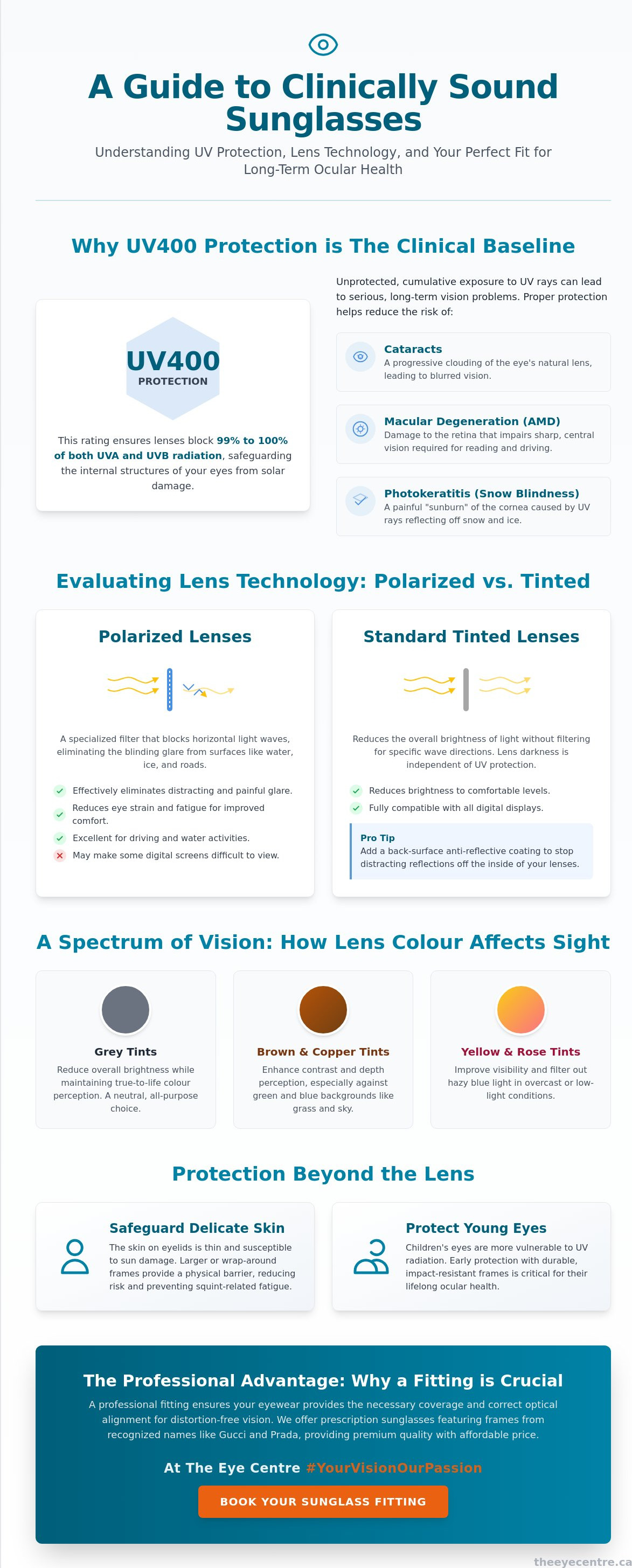
Quality sunglasses are more than just a seasonal accessory; they are essential medical tools for preserving your sight. Clinical safety begins with UV400 protection. This rating ensures that lenses block 99 to 100 percent of UVA and UVB radiation, preventing harmful rays from reaching the internal structures of the eye. Without this barrier, the eye remains vulnerable to various forms of solar damage that can lead to permanent vision loss.
The damage from solar radiation is cumulative, meaning it builds up over a lifetime. Consistent, unprotected exposure contributes to the clouding of the eye's natural lens, a condition known as cataracts. There is also a documented link between UV exposure and the development of age-related macular degeneration (AMD), which damages the retina and impairs central vision. In our local climate, protection is vital during the winter months. Photokeratitis, often called snow blindness, occurs when UV rays reflect off ice and snow, causing a painful sunburn on the cornea. At The Eye Centre #YourVisionOurPassion, we emphasize that your quality of vision is too important to ignore.
Protecting the Delicate Skin Around the Eyes
The skin on your eyelids is among the thinnest on your body, making it highly susceptible to UV damage. A significant percentage of skin cancers occur on the eyelids, and choosing wrap-around frames provides the physical coverage needed to reduce this risk. Quality eyewear also prevents repetitive squinting, which reduces premature fine lines and ocular fatigue. We recommend starting with a comprehensive eye exam to establish your baseline health and discuss specific protection needs. We offer frames that provide premium quality with affordable price options to ensure safety is accessible to everyone.
Children and Sun Protection: A Critical Window
Children are at a higher risk for UV-related ocular damage because their pupils are larger and their internal lenses are clearer than those of adults. This allows more radiation to penetrate deep into the eye. Protecting young eyes early is a vital part of pediatric care. When selecting frames for active children, we focus on durable, impact-resistant materials that maintain a secure fit during play. Establishing good habits now helps prevent serious complications in the future.
Evaluating Lens Technology: Polarized vs. Tinted Sunglasses
Selecting the right lenses involves understanding how different technologies interact with light. Polarization is a specific filter designed to block horizontal light waves. When sunlight hits flat surfaces like water, ice, or a highway, it reflects horizontally, creating the blinding glare that causes squinting and discomfort. Polarized lenses act like a vertical blind, allowing only useful vertical light to reach your eyes. This makes them an excellent choice for driving and water activities where visual clarity is a safety requirement. Beyond immediate comfort, the health benefits of wearing sunglasses with these filters include a significant reduction in eye fatigue and strain.
While polarization is effective for glare, standard tinted lenses have their own advantages. Some digital displays, such as car dashboards or certain mobile devices, can become difficult to read through polarized filters. In these cases, a high-quality tint provides necessary light reduction without interfering with screen visibility. To further improve your experience, we often recommend back-surface anti-reflective coatings. These coatings stop light from reflecting off the inside of the lens and into your eye, which is a common source of distraction. At The Eye Centre #YourVisionOurPassion, we guide you through these technical choices to ensure your eyewear performs exactly how you need it to.
Lens Colour and Visual Contrast
The colour of your sunglasses changes how you see contrast and depth. Grey lenses are a neutral choice that reduces brightness while keeping colours true to life. Brown or copper tints are functional for activities requiring high contrast, as they enhance depth perception against green and blue backgrounds. For overcast days or low-light environments, yellow or rose tints can improve visibility by filtering out hazy blue light. You can view our range of lens options by visiting The Eye Centre to find your perfect match.
Durability and Material Standards
Lenses are available in various materials to suit different needs. Glass lenses offer high optical clarity but are heavier and prone to shattering. Polycarbonate is the preferred material for active users because it is lightweight and provides superior impact resistance. To ensure your investment lasts, we include scratch-resistant treatments that protect the lens surface from daily wear. We focus on providing premium quality with affordable price options, so you never have to choose between durability and value.
Prescription Sunglasses and Professional Fitting in Canada
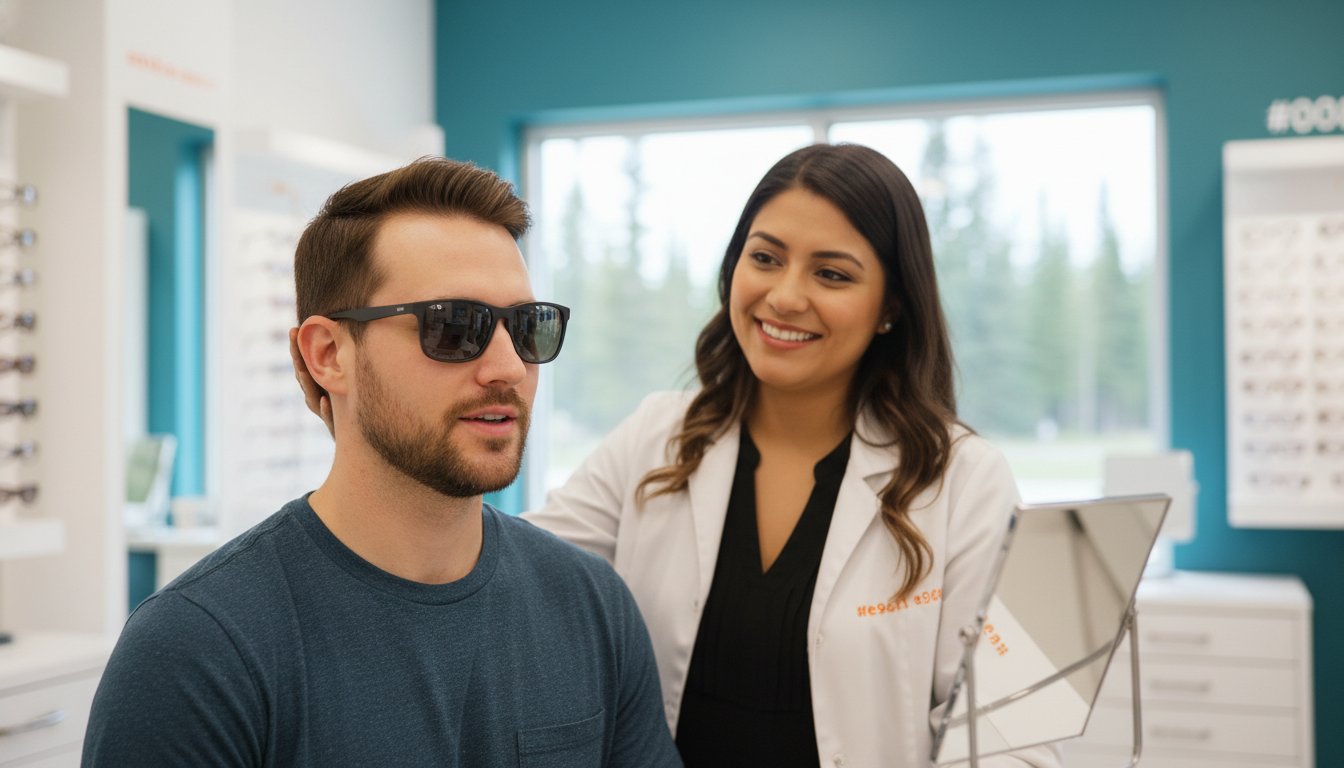
For individuals who require vision correction, prescription sunglasses offer a seamless transition between indoor and outdoor environments without compromising on clarity. These specialized lenses provide distortion-free vision tailored to your specific refractive needs, which is something standard over-the-counter options cannot replicate. We integrate luxury brands such as Gucci and Prada with high-index sun lenses to ensure your eyewear remains thin and lightweight. At The Eye Centre #YourVisionOurPassion, we ensure your frames are optimized for your unique facial structure, providing a secure fit that remains comfortable throughout the day.
A professional fitting at a clinical practice is essential for more than just aesthetic reasons. It ensures that the frames sit at the correct distance from your eyes to minimize light leakage around the edges. Understanding how sunglasses protect your eyes involves looking at more than just the lens; the frame wrap and positioning are vital for blocking peripheral UV radiation. Our team focuses on providing premium quality with affordable price options, making high-standard ocular protection accessible to our local community.
Addressing Glare in Alberta and Saskatchewan
Living in Fort McMurray or Prince Albert presents unique environmental challenges that require specialized eyewear. Snow glare is a significant concern in the prairies, as snow can reflect a large percentage of UV radiation back into the eyes. The high-altitude sun in these regions remains a factor even on overcast days, making consistent protection necessary year-round. For those who lead active lifestyles or work outdoors, our Ray-Ban and Oakley options offer high-wrap performance to shield your eyes from every angle.
Beyond Fashion: The Value of a Clinical Consultation
A clinical consultation allows an optometrist to tailor lens choices to specific health conditions. For instance, patients dealing with dry eye often find that certain frame styles and lens tints help manage their symptoms by reducing wind exposure and light sensitivity. We also provide safety-rated sun protection for industrial workers who need impact resistance alongside UV blocking. We encourage you to contact us for a personalized fitting session to ensure your vision is protected in every environment.
Prioritizing Your Long-Term Vision
Protecting your eyes from solar radiation is a lifelong commitment that requires more than just a dark lens. We have explored how UV400 protection serves as a clinical baseline for safety and how specific lens technologies like polarization reduce the strain caused by Canadian snow glare. Choosing the right sunglasses is a decision that balances medical necessity with your personal lifestyle. Your quality of vision is too important to ignore, and we are here to help you look and see with clarity in every season.
At The Eye Centre #YourVisionOurPassion, we are an authorized dealer for Maui Jim, Oakley, and Ray-Ban. Every purchase includes a professional optometric fitting to ensure your frames provide functional coverage and comfort. We also offer direct billing for most insurance plans to make your experience as seamless as possible. You can find options that offer premium quality with affordable price across our locations.
Book an eye appointment to find your ideal prescription sunglasses today. We look forward to helping you protect your sight for years to come.
Frequently Asked Questions
Is it worth getting polarized sunglasses for driving in Saskatchewan?
Yes, polarized lenses are highly effective for driving in Saskatchewan due to the intense glare produced by snow and ice. Our prairie landscape creates horizontal reflections off flat roads and frozen surfaces, which often leads to significant eye strain and reduced visibility. At The Eye Centre #YourVisionOurPassion, we recommend polarization to improve your reaction times and visual comfort during long commutes. These lenses provide premium quality with affordable price while effectively neutralizing the harsh light that bounces off the winter terrain.
Can I turn any designer frame into prescription sunglasses?
Most designer frames can be converted into prescription sunglasses, provided the frame structure supports the thickness and weight of your corrective lenses. While many frames from brands like Gucci, Prada, or Ray-Ban are compatible, certain high-wrap or rimless styles may have limitations based on your specific prescription strength. Our opticians perform a professional fitting to ensure your chosen frame maintains its shape and provides the necessary coverage. We focus on optimizing every pair to ensure your vision remains clear and your eyes stay protected.
Do dark lenses always provide better UV protection than lighter tints?
No, the darkness of a lens does not determine its ability to block UV radiation. UV protection is a clear treatment applied to the lens material, meaning even a light-tinted lens can offer 100 percent UV400 blockage. In fact, wearing dark lenses without a proper UV filter is dangerous. The dark tint causes your pupils to dilate, which allows more harmful radiation to enter the eye if the protective coating is missing. Your quality of vision is too important to ignore, so always verify the UV rating regardless of the lens colour.
How often should I replace my sunglasses to ensure they still block UV rays?
You should consider replacing your sunglasses every two to three years if they are used daily, as UV protection can gradually diminish over time. Exposure to the elements and physical wear can cause the protective layers to degrade. Scratches on the lens surface also compromise the barrier, allowing radiation to reach your eyes. Regular check-ups at a clinic help determine if your current eyewear still meets clinical safety standards. We provide options that offer premium quality with affordable price to ensure you can update your protection as needed.


