What if your standard eyeglasses are actually increasing your risk of injury on the job site? Many workers in Canada rely on everyday frames that simply aren't designed to withstand high-velocity impacts or the harsh rigours of our local climate. You've likely felt the frustration of your glasses slipping under bulky goggles or fogging up during a cold morning shift. It's a common struggle, but your safety and your quality of vision are too important to ignore.
At The Eye Centre #YourVisionOurPassion, we understand that you need a solution that balances clinical precision with industrial strength. In this guide, you'll learn exactly how to choose prescription safety glasses that meet CSA Z94.3 compliance requirements without sacrificing comfort. We'll show you how to achieve clear, distortion-free vision and find a pair that offers premium quality with affordable price. From understanding lens materials like polycarbonate to ensuring a secure fit for all-day wear, we'll cover everything you need to stay protected and productive at work.
In this guide, you will learn:
- Why standard eyeglasses are not a substitute for specialized safety frames and the risks they pose on hazardous job sites.
- How to identify the appropriate lens material for your environment, including the benefits of Polycarbonate and Trivex.
- The importance of a professional fitting to ensure the optical centre of your prescription safety glasses aligns perfectly with your vision.
- How to select CSA-approved eyewear that delivers premium quality with affordable price for all-day comfort. At The Eye Centre #YourVisionOurPassion.
Why Standard Eyeglasses Are Not a Substitute for Prescription Safety Glasses
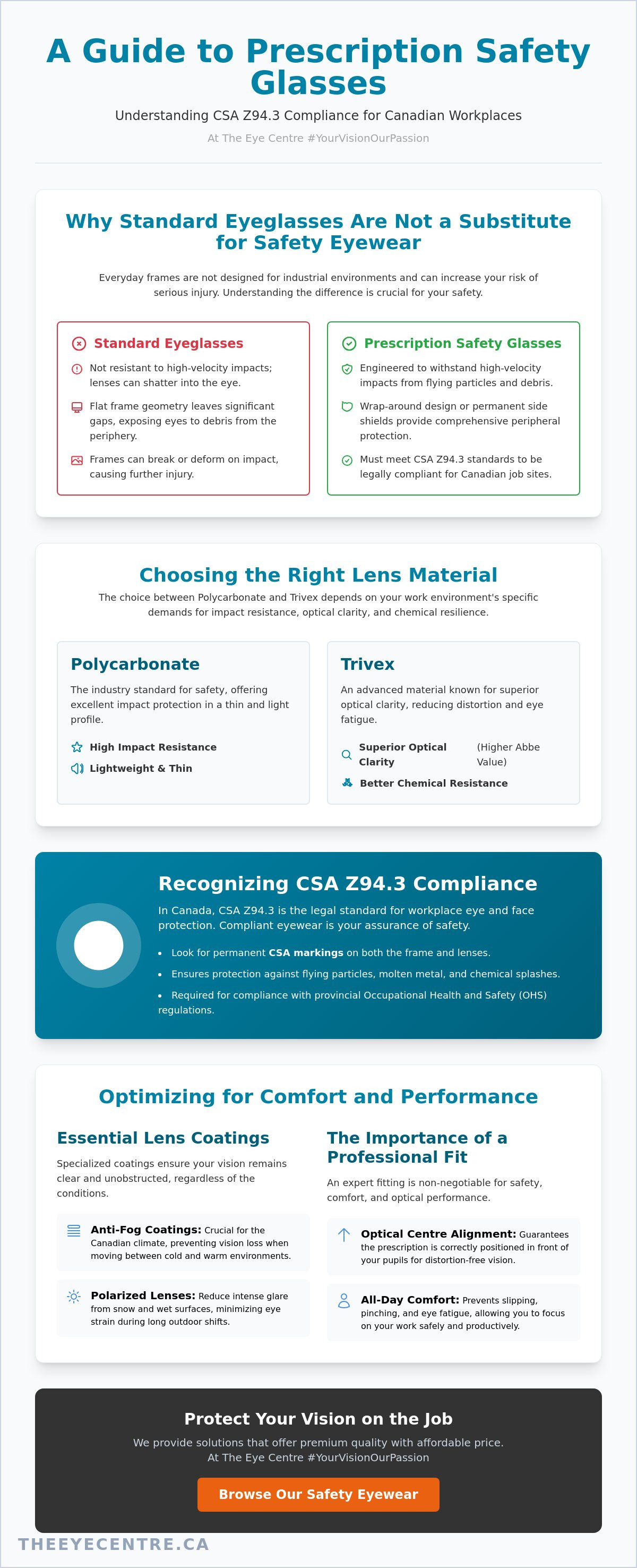
Your everyday designer frames are crafted for style and basic vision correction, but they aren't built to survive a rugged industrial environment. Prescription safety glasses are specialized medical devices engineered to withstand high-velocity impacts that would shatter standard plastic or metal. If a projectile hits a regular pair of glasses, the frame can fail or the lens can displace directly into the eye, causing severe injury. Safety frames use a wrap-around design to minimize gaps, unlike the flat geometry of office spectacles. This structural difference ensures that debris doesn't reach your eyes from the periphery during a busy shift.
Recognizing CSA Z94.3 Compliance
In Canada, the CSA Z94.3 standard is the legal benchmark for workplace protection. You can identify compliant gear by looking for permanent markings on both the frame and the lenses; typically, you'll find the CSA logo or the manufacturer's specific mark etched into the material. Depending on your trade, you might require permanent side shields or removable versions for lighter tasks. Impact resistance in Canadian industrial safety refers to the ability of the eyewear to protect against flying particles, molten metal, and chemical splashes without fracturing or allowing lens displacement. Understanding these eye protection standards helps you stay safe and compliant with provincial OHS regulations.
The Ocular Health Risks of Non-Compliant Gear
Wearing ill-fitting or non-compliant gear often leads to eye fatigue, which reduces your productivity and focus during a long work day. It's vital to have comprehensive eye exams before ordering your lenses to ensure your prescription is accurate for your specific working distances. At The Eye Centre #YourVisionOurPassion, we prioritize your long-term health alongside your immediate safety. We provide options that offer premium quality with affordable price, ensuring you don't have to compromise on your well-being. Keeping your vision clear and your eyes protected is a responsibility we take seriously.
How to Select the Right Prescription Safety Eyewear for Your Environment
Choosing the right prescription safety glasses requires a clear understanding of your daily work environment. You can follow a simple four-step process to ensure your eyes remain shielded from potential harm. First, identify your primary hazards, whether they involve fine dust, high-velocity particles, chemical splashes, or harmful radiation. Once the risks are clear, you can select the appropriate lens material and a frame style that matches your facial structure to eliminate dangerous gaps. Finally, adding essential coatings like anti-fog and anti-scratch treatments ensures your gear remains functional throughout its lifespan.
Lens Materials: Polycarbonate vs. Trivex
For workers in high-intensity industries like those found in Fort McMurray, lens material choice is a balance of weight and optical clarity. Polycarbonate is the standard for impact resistance; it's lightweight and thin. However, Trivex offers a higher Abbe value, which means it provides superior optical clarity with less colour distortion. Trivex also boasts better chemical resistance, making it a reliable choice for laboratory or industrial cleaning environments. We utilize digital lens surfacing to realize wider fields of vision, even in wrap-around frames, which is essential for maintaining situational awareness on a busy site. Proper workplace eye protection starts with these technical decisions.
Managing the Canadian Climate: Anti-Fog and Tint Options
Canadian winters present unique challenges, particularly when moving from a heated truck cab to a freezing outdoor site. This temperature transition often causes immediate fogging, which can be dangerous if it happens while operating machinery. We recommend high-performance anti-fog coatings to keep your vision clear in these moments. For those working in Prince Albert or Yorkton, snow glare can be a significant issue. Polarized safety lenses help manage this intense light, reducing strain during long outdoor shifts. At The Eye Centre #YourVisionOurPassion, we provide these advanced features to ensure you receive premium quality with affordable price. If you aren't sure which coatings fit your trade, you can browse our safety eyewear options to see what suits your needs.
The Professional Fitting Process: Realizing Comfort and Compliance
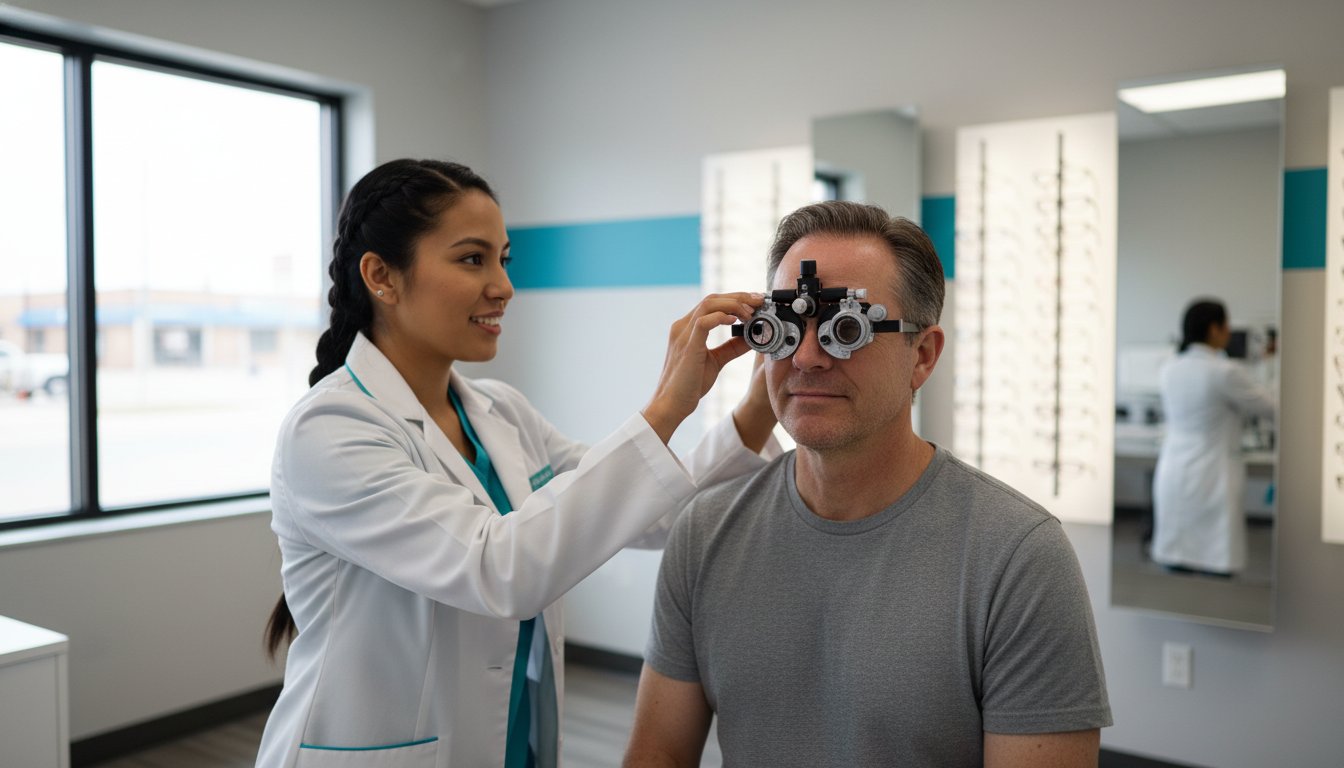
Online ordering might seem convenient, but it often misses the technical adjustments required for workplace safety. A professional fitting ensures the optical centre of the lens aligns perfectly with your pupil. This precision is vital for prescription safety glasses, as even a minor misalignment can cause headaches or distorted vision. Our opticians manage complex measurements like vertex distance and pantoscopic tilt to ensure your vision remains sharp. This transition from a comprehensive eye test to the final dispensing of your eyewear is a clinical process, not just a retail transaction.
We help you choose from reliable brands like Oakley or specialized industrial frames that provide durability. A proper frame adjustment prevents uncomfortable pressure points during a long 12-hour shift. Aligning your eyewear with technical benchmarks like OSHA's eye and face protection standards ensures you're both legally covered and physically protected. It's about more than just a pair of glasses; it's about ensuring your gear doesn't fail when you need it most.
What to Bring to Your Safety Eyewear Consultation
When you arrive for your fitting, please bring your current prescription and any specific workplace requirements provided by your employer. If your company uses a specific safety voucher program, we recommend contacting us beforehand to streamline the process. To ensure total compatibility with your other personal protective equipment, consider bringing the following items to your appointment:
- Your work helmet or hard hat.
- Hearing protection or earmuffs used on the job.
- Any specific masks or respirators you wear regularly.
Insurance, Safety Vouchers, and Coverage in AB & SK
Many employer health plans in Alberta and Saskatchewan include safety allowances that can be applied to your purchase. It's important to recognize that these are medically necessary safety devices rather than simple retail products. We strive to offer options that provide premium quality with affordable price to help you stay within your budget. We invite you to visit a location in Yorkton, Prince Albert, or Fort McMurray for a personalized assessment. At The Eye Centre #YourVisionOurPassion, your safety is our priority.
Secure Your Sight for Every Shift
Protecting your eyes on the job requires more than just a sturdy frame. It involves selecting prescription safety glasses that meet strict CSA Z94.3 standards while providing the clarity needed for complex tasks. Choosing the right lens materials and climate-specific coatings ensures you remain productive in even the most demanding Canadian environments. Your quality of vision is too important to ignore; a professional fitting is the only way to guarantee that your eyewear remains comfortable through every hour of your workday.
We offer specialized expertise for industrial and high-heat environments, ensuring your gear is both durable and functional. To make the process easier, we provide direct billing for many major Canadian insurance providers. At The Eye Centre #YourVisionOurPassion, we prioritize health and safety by offering premium quality with affordable price. Don't leave your ocular health to chance when you can have reliable protection tailored to your trade.
Book your eye exam and safety eyewear fitting at The Eye Centre today to find the right solution for your workplace needs. We look forward to helping you see your best at one of our local clinics.
Frequently Asked Questions
Are prescription safety glasses covered by my employer in Canada?
Many employers in Canada provide specific safety allowances or health spending accounts to cover the cost of prescription safety glasses. It's common for collective agreements or company policies to mandate that the employer pays for or subsidizes CSA-approved eyewear for workers in hazardous environments. You should check your specific benefits package or safety manual to see if you qualify for direct billing or a reimbursement program at our locations.
Can I just use safety over-glasses (OTGs) instead of a prescription pair?
While over-the-glasses (OTG) protectors are a temporary solution, they often cause issues like fogging, slipping, and reduced peripheral vision. Prescription safety glasses provide a much more secure and comfortable fit because they are integrated into a single frame. This reduces the weight on your nose and eliminates the distortion that often occurs when looking through two sets of lenses simultaneously. At The Eye Centre #YourVisionOurPassion, we prioritize your comfort and safety.
How often should I replace my prescription safety glasses?
You should generally replace your safety eyewear every one to two years, or sooner if the lenses become scratched or the frame shows signs of fatigue. Scratches on safety lenses can impair your vision and weaken the impact resistance of the material. Additionally, your vision prescription may change over time, making an updated pair necessary to maintain sharp focus. We offer premium quality with affordable price to make these regular updates manageable.
What is the difference between ANSI Z87.1 and CSA Z94.3?
ANSI Z87.1 is the American technical standard for eye protection, while CSA Z94.3 is the specific standard required for Canadian workplaces. While both standards involve rigorous impact testing, Canadian provincial OHS regulations typically mandate that eyewear must be CSA-approved to be legally compliant on local job sites. Always look for the CSA mark on your frames to ensure you meet the legal requirements for your specific trade.


